6 SaaS words, in plain English
MRR and ARR, churn, runway, pipeline, roadmap and LTV. What each word counts, one fictional team's numbers worked through, and what each number doesn't tell you.
Watch the reel
A team chat at a software company. Dan, from Sales, is excited. Maya, the CEO, is not so sure:
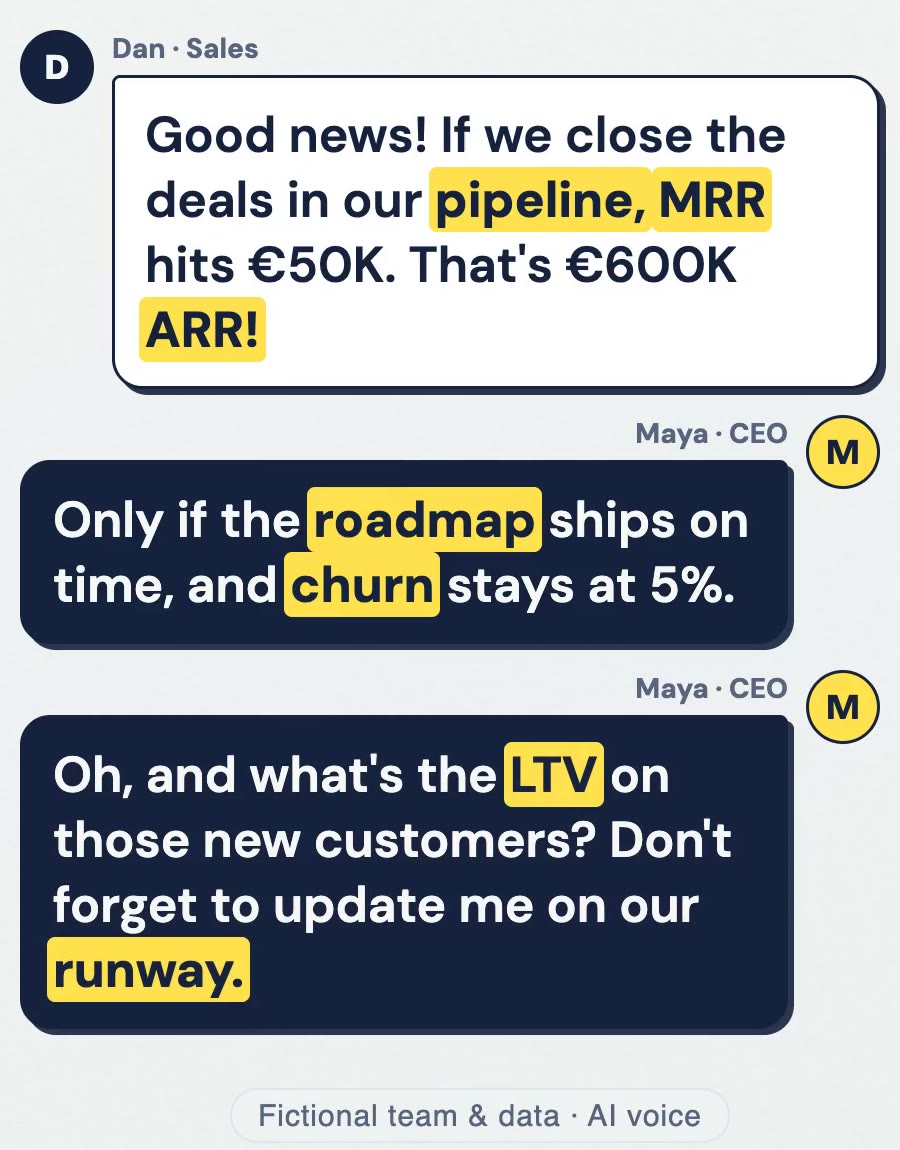
If you've ever nodded along to a message like this, you're not alone. SaaS means software as a service: software you pay for by subscription instead of buying it once. Companies that sell it have their own vocabulary, and it travels well beyond the finance team.
Here are the six words, one at a time: what each one counts, the team's numbers worked through, and what the number doesn't tell you. The team, the company and every figure on this page are fictional.
MRR and ARR
MRR is monthly recurring revenue: what subscriptions bring in every month. Stripe describes it as the monthly revenue a business can reliably expect to receive on a recurring basis. One-off payments, like a setup fee, don't count.
In the example, 500 customers each pay €100 a month. 500 × €100 = €50K MRR.
ARR is annual recurring revenue. Stripe calculates it by multiplying MRR by 12. So €50K × 12 = €600K ARR.
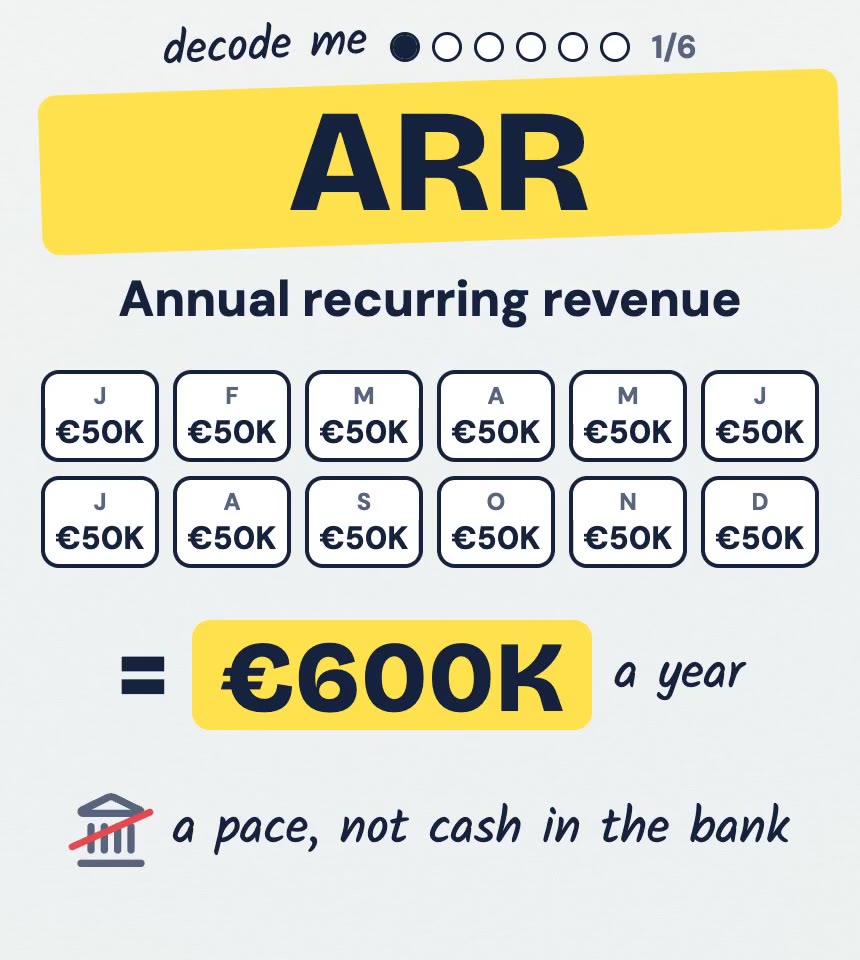
Here is the part that trips people up. ARR is a pace, not cash in the bank. It says "if this month's subscriptions simply continued for a year, this is what they would add up to". Nobody has paid €600K. Stripe itself points out that MRR is not GAAP (accounting) revenue, and that it's distinct from the cash you're about to receive.
So when Dan says "€600K ARR", read it as: if we close those deals, our monthly subscriptions would be running at a €600K-a-year pace.
Churn
Churn is the share of customers who leave in a period. The usual recipe: customers who cancelled during the period, divided by customers you had at the start.
In the example, 25 of the 500 customers cancel this month. 25 ÷ 500 = 5% churn. Ouch.
Two things to check before you compare churn numbers:
- Which period? 5% a month and 5% a year are very different businesses.
- Customers or money? Customer churn counts people who leave. Revenue churn counts the revenue lost, including customers who move to a cheaper plan. Here every customer pays the same €100, so both come out at 5%. If the 25 who left had been your smallest customers, revenue churn would be lower than 5%.
Runway
Runway is how long the cash lasts. It's measured in months: cash in the bank, divided by the net amount you burn each month. Net means money going out minus money coming in.
In the example, the company has €300K in the bank and burns a net €30K a month. €300K ÷ €30K = ten months before it runs out.
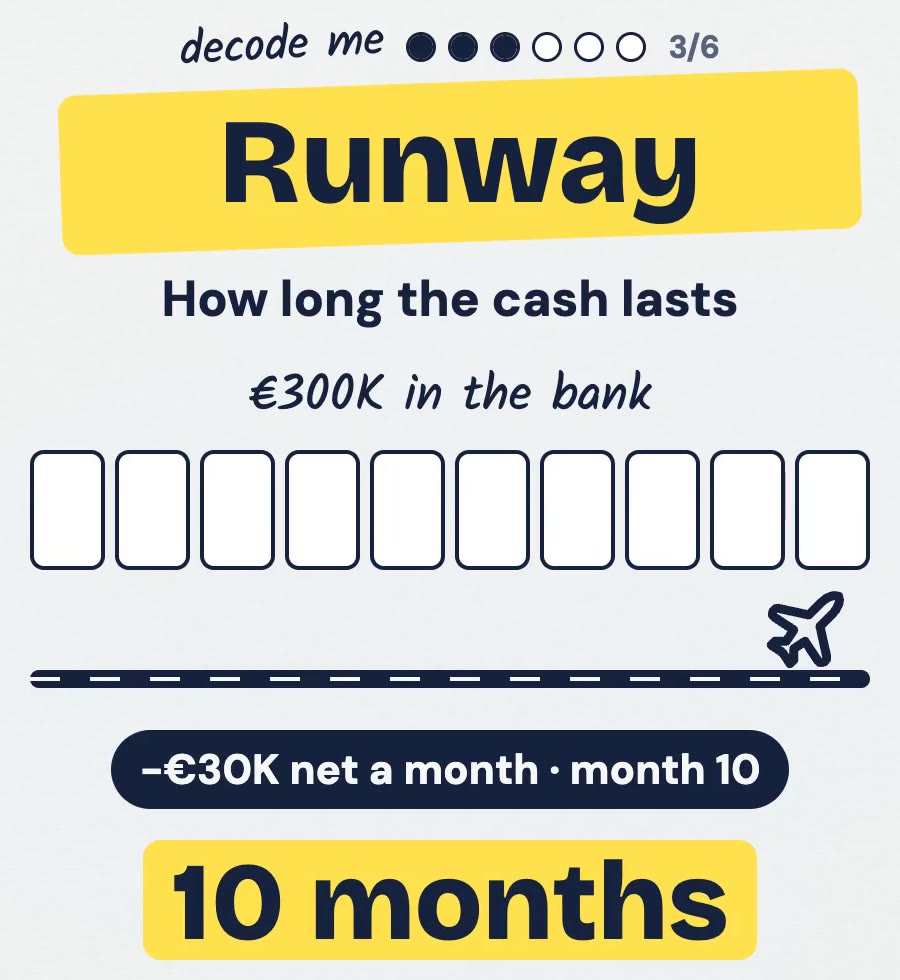
Two limits. Runway assumes the pace stays the same, and real months vary. And it's calculated from cash, not from ARR: a €600K pace doesn't pay this month's salaries. That's why Maya asks for it.
Pipeline
The pipeline is all the deals still in progress. Salesforce describes it as a picture of where each prospect is in the sales process: for example, first call, demo, proposal, contract.
Every deal you close moves out of the pipeline and pushes MRR up. Until then, it's a possibility, not revenue. That's the word to notice in Dan's message: if we close the deals.
Roadmap
The roadmap is the plan of what gets built, and when. New features, fixes and integrations, in order, with rough dates.
It sounds like a product-team document, but it touches sales too. In this fictional team, some customers are waiting for a feature before they sign. Ship late, and those deals have to wait. That's Maya's first condition.
LTV
LTV is lifetime value: what a customer pays you over the whole time they stay. Stripe calls it a predictive metric, based on assumptions and historical data. It's an estimate, not a fact.
The simplest version takes two steps. First, how long does a customer stay? If 5% of customers leave each month, a customer is expected to stay about 1 ÷ 5% = 20 months. Stripe's own guide to the business of SaaS uses that same example. Second, multiply by what they pay: 20 × €100 = about €2,000.
Two honest notes. That €2,000 is revenue, before costs. It isn't profit, and some versions of LTV subtract costs or apply a margin, so ask which one you're looking at. And it only holds if churn stays at 5%, which is exactly Maya's second condition.
Now read it again
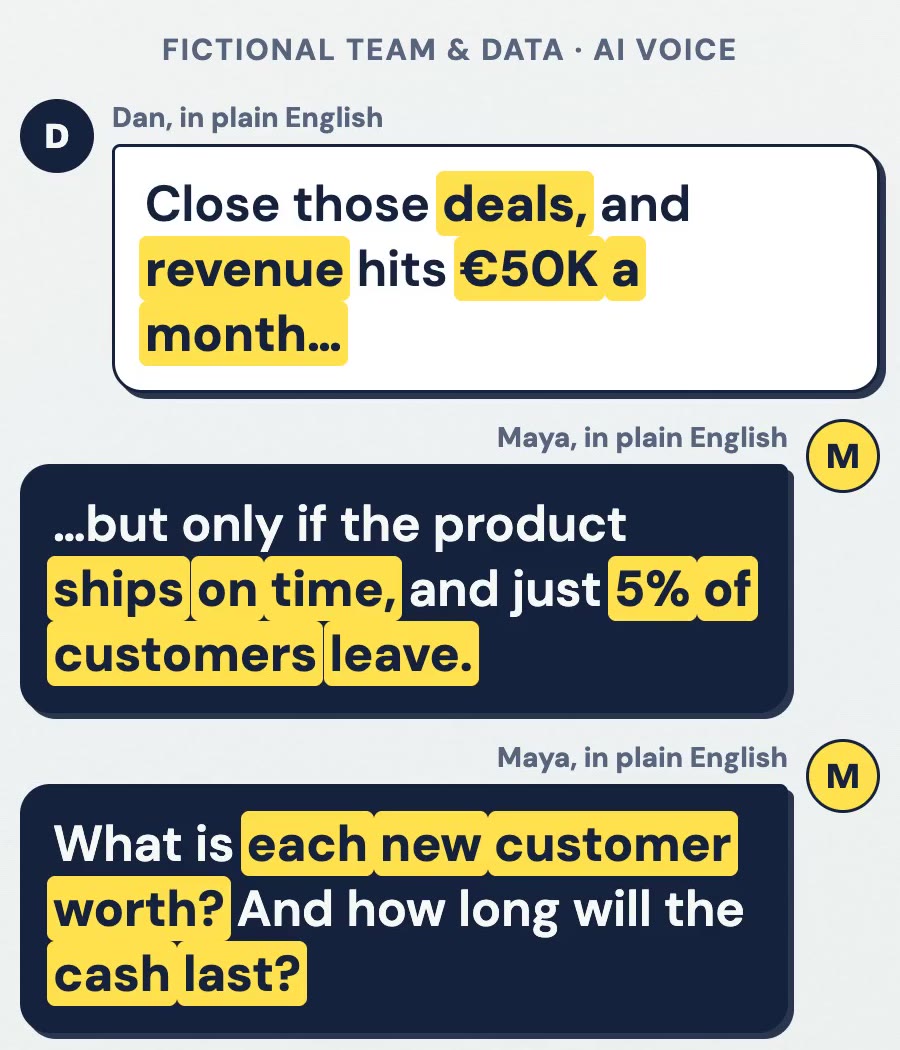
In plain English, the chat says: if Sales closes the deals they're working on, subscriptions will bring in €50K a month. That only works if the product ships on time and only 5% of customers leave each month. And the CEO still has two open questions: what is each new customer worth, and how long will the cash last?
Notice what didn't change. Dan's "if" is still an "if". Maya's questions are still questions. Translating the jargon doesn't make the numbers more certain. It just shows you what to ask.
One habit helps more than any glossary. Before comparing two SaaS numbers, ask three things: what's counted, over which period, and with which definition.
Which word next?
This is episode 2 of Plain English, please. The first one decoded 7 AI words. Tell us on Instagram which business word still confuses you, and we'll decode the most-asked ones next.
Sources
- Stripe Support: Understanding MRR and ARR (consulted 11 November 2026)
- Stripe: Essential SaaS metrics (last updated 13 April 2026; consulted 11 November 2026)
- Stripe: Customer churn rates 101 (consulted 3 November 2026)
- Stripe Atlas: The business of SaaS (consulted 11 November 2026)
- Stripe Atlas: Cash management, step 3 (consulted 11 November 2026)
- Salesforce: Sales pipeline (consulted 11 November 2026)
- Atlassian: Product roadmaps (consulted 3 November 2026)
Fictional team, company and figures; not financial or investment advice. The reel is an illustration: its chat and screens are drawn. Definitions paraphrase the sources above; "a pace, not cash in the bank" is our own wording, not Stripe's. AI voices by ElevenLabs (Marcus, Jesse and Sunny). Music: “The Duel” by Michael Ramir C. (Mixkit).