7 AI words, in plain English
Prompt, context window, token, RAG, API, MCP and Markdown. Each one explained in a sentence, with an everyday picture and what it means when you use AI.
Someone sends you a message like this one, and you reply "sure 👍" without understanding half of it:
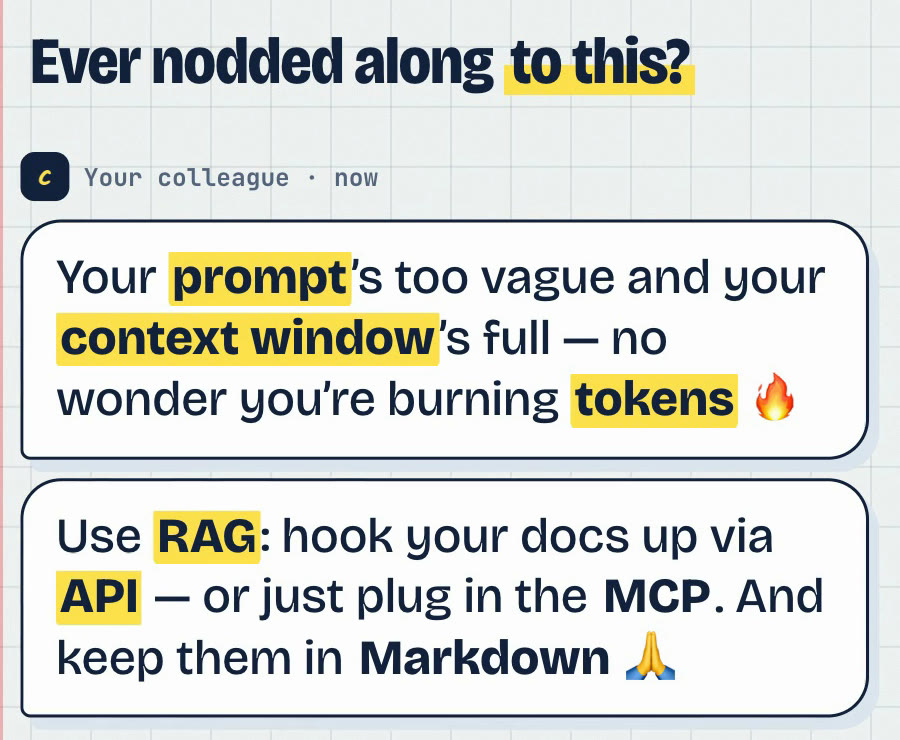
Every word in that message means something real, and together they describe a real problem and its fix. Here they are one at a time: what each word means, an everyday picture, and why it matters when you use AI.
Prompt
Whatever you type to the AI. A question, an instruction, a pasted email. All of it is the prompt.
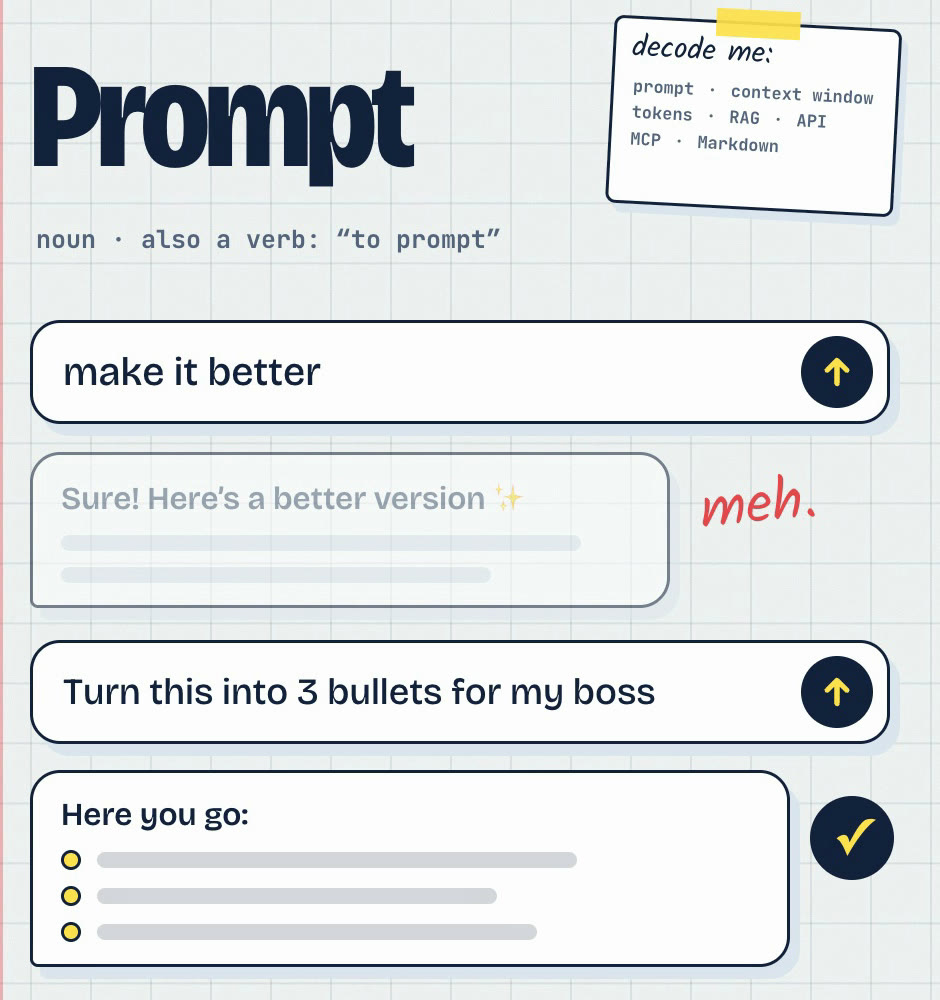
Type "make it better" and you get something vague back. Type "turn this into three bullets for my boss" and you get exactly that. A clear prompt says what you want, who it's for and what it should look like when it's done.
↑ The prompt is only half of it. What the AI can see besides your sentence matters just as much. That was our first note: not a better prompt, better context.
Context window
How much the AI can keep in mind at once. It's also simply called "the context".
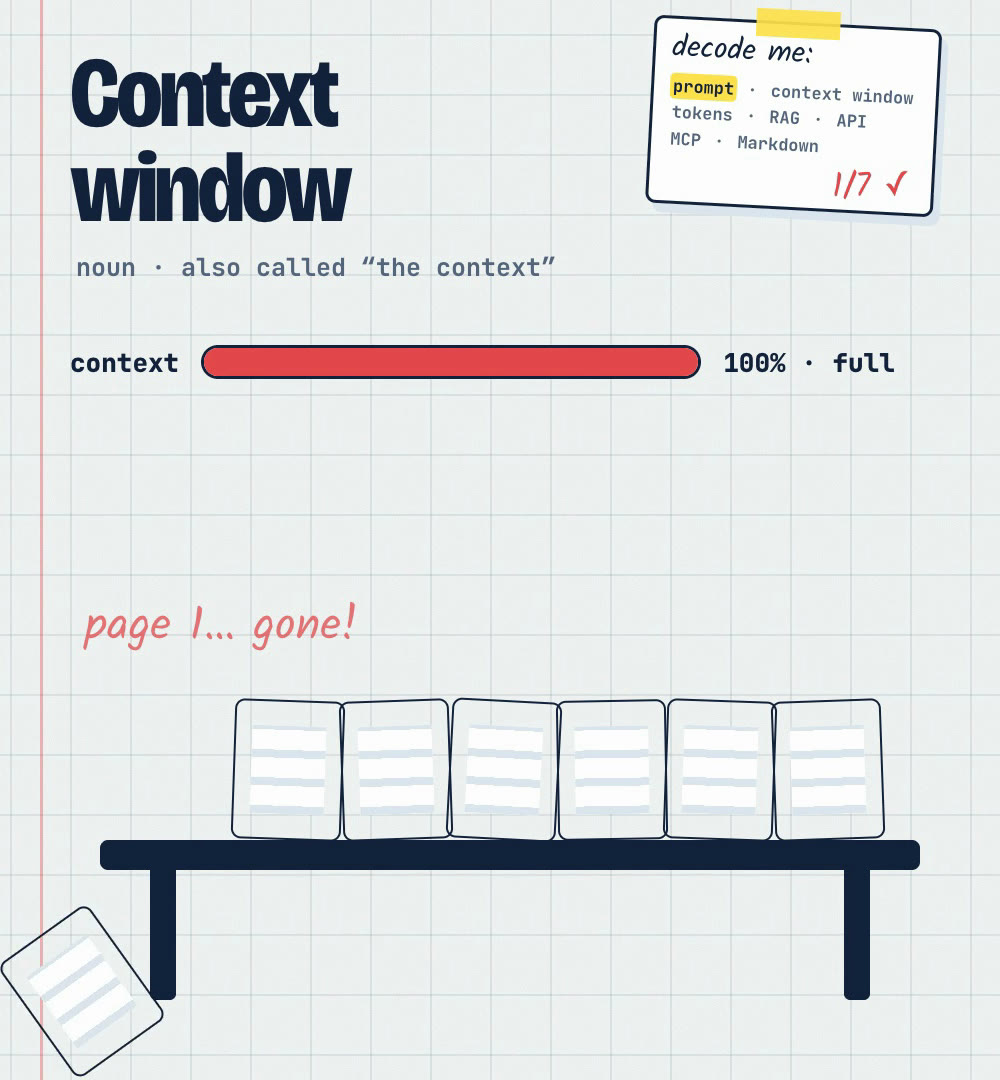
Picture a desk. Every message, every file and every answer goes on the desk. The desk is big, but it has an edge. When it fills up, the app has to make room. Depending on the app, it summarizes the older part of the chat, drops it, or asks you to start a new one. Either way, details from the beginning can get lost.
That's why long chats get forgetful. It isn't the AI getting tired. The early pages simply aren't on the desk anymore.
Token
The little pieces AI reads text in. Not letters and not words: pieces.
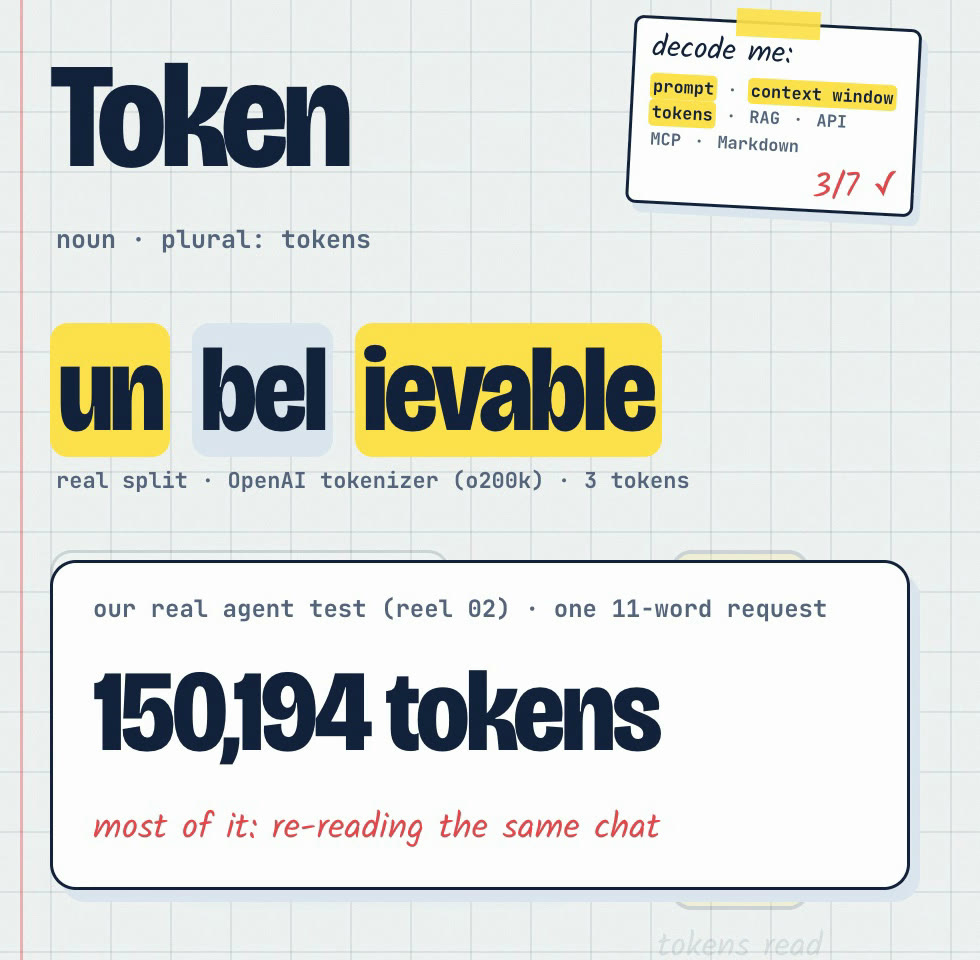
On its own, "Unbelievable" is three tokens in one of OpenAI's tokenizers: Un, bel, ievable. Inside a sentence, " unbelievable" with the space before it is just one. Common chunks of text get a token of their own, so tokens aren't syllables. Every company's models split text a little differently. The message at the top of this note is 34 words and 42 tokens.
Tokens matter because they're what you pay for and what fills the context window. And every new message re-reads the whole chat. In our own test, a request of 11 words used 150,194 tokens, almost all of it spent re-reading. Where your tokens go explains why, and how to keep it lean.
RAG
Retrieval-Augmented Generation. Catchy, right? It means the AI looks things up first, then answers.
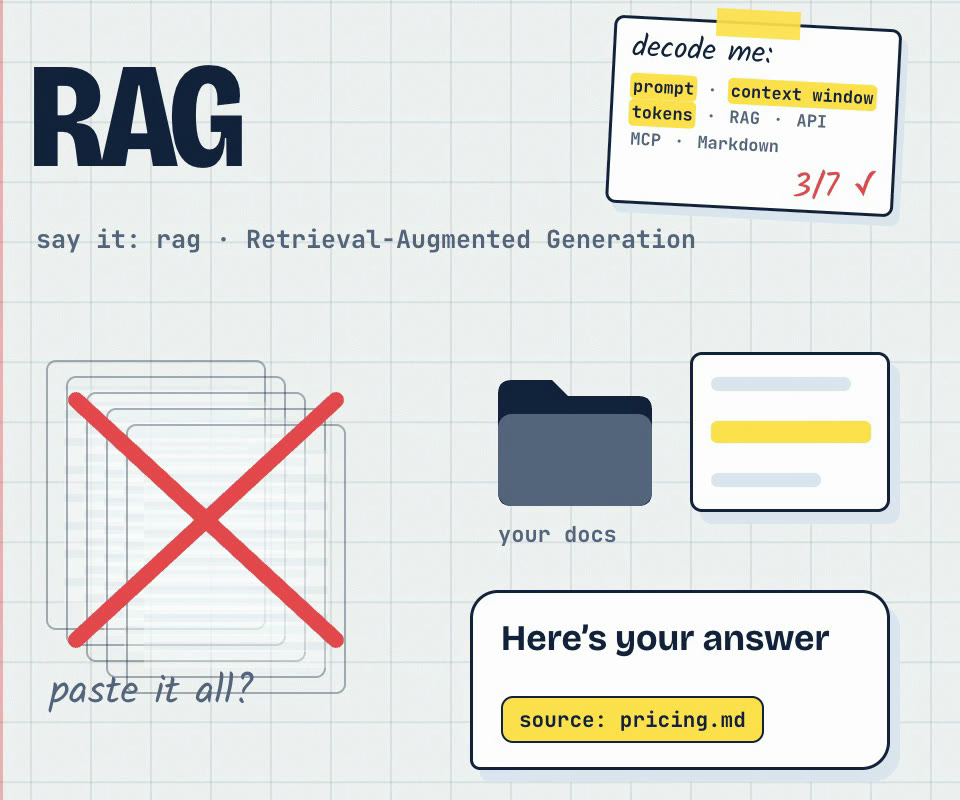
Instead of pasting all your documents into the chat, the AI searches them, picks the few pages it needs and answers from those. It's an open-book exam. Good RAG also tells you which page the answer came from, so you can check it.
You've probably used it without the name. Tools that answer questions about your own files work this way. NotebookLM is one.
API
Application Programming Interface. The name helps exactly nobody, so think of a restaurant.
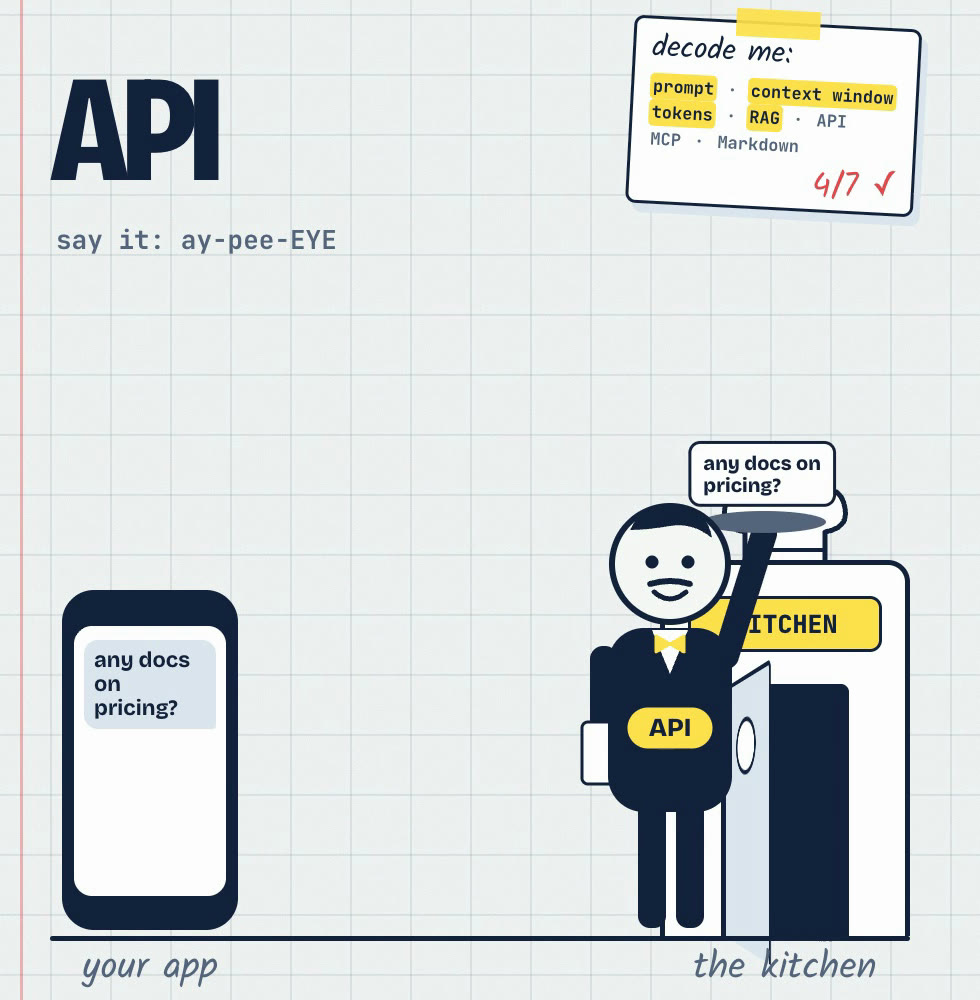
You don't walk into the kitchen. You tell the waiter, the waiter tells the kitchen and brings the dish back. An API is that waiter between two apps: one app orders, the other one cooks, and neither needs to know how the other works inside.
A real one from our side: when our news radar runs at 6 in the morning, it hands its page to the company that hosts this website, through that company's API. Nobody clicks anything. That's how /radar gets its update.
MCP
Model Context Protocol. A name only an engineer could love.
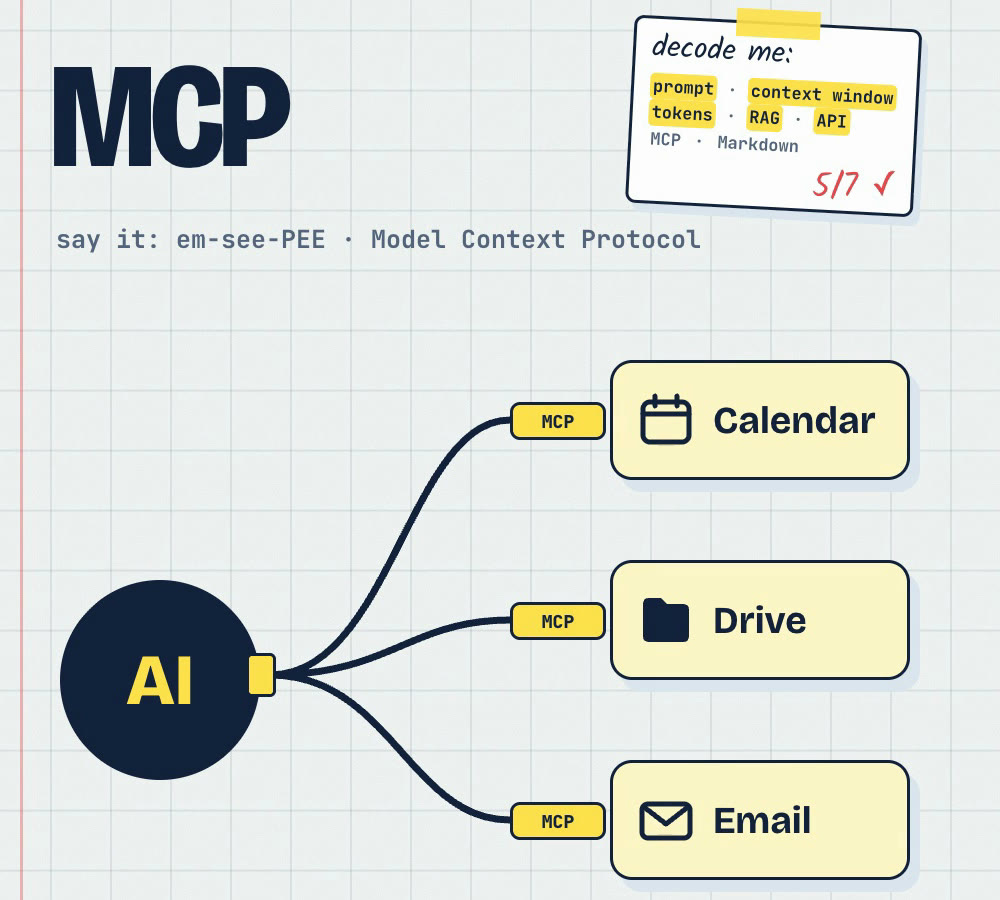
MCP is one standard way to connect an AI assistant to your apps: your calendar, your drive, your email. Its own documentation puts it like this: "Think of MCP like a USB-C port for AI applications." Before USB-C, every device had its own cable. Now one plug fits.
In the Claude app these connections are called connectors. The voices in our video came through one: our assistant connected to ElevenLabs, the voice app, and made the takes from there.
↑ A plug works both ways. Connect only the apps a task needs, and keep the "ask before you send, delete or publish" rule on.
Markdown
A simple way to format plain text. If you've ever pasted an AI answer somewhere and got weird little stars and hashes everywhere, that was Markdown.
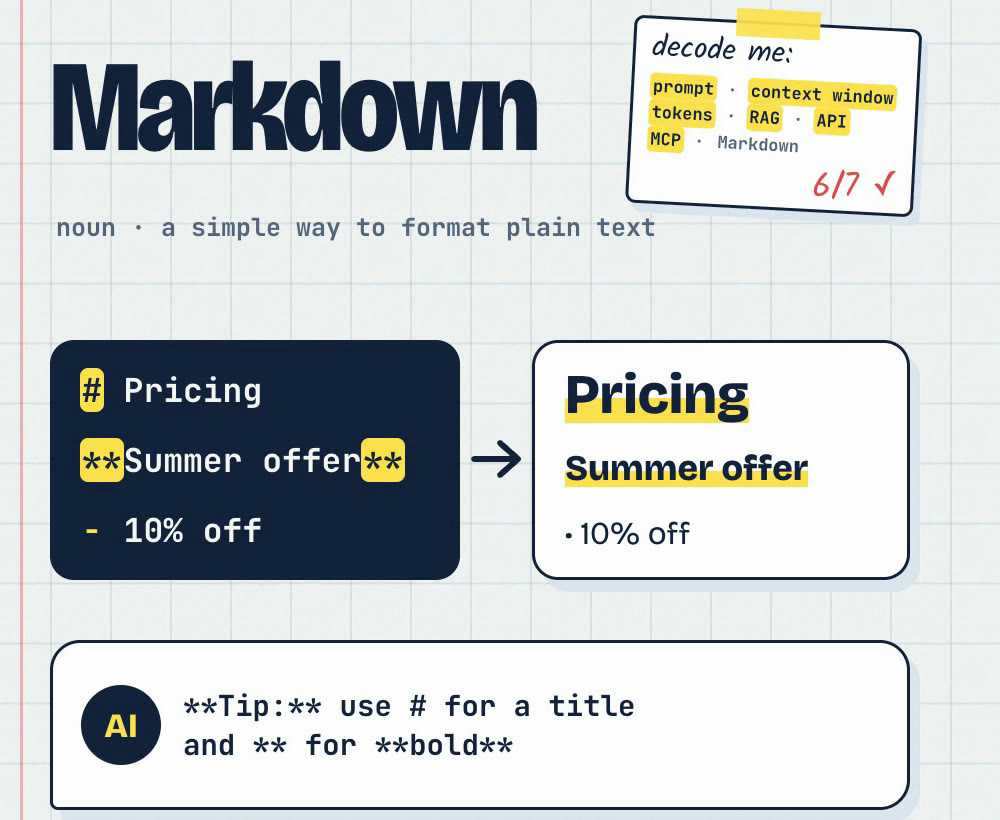
A # at the start of a line makes a title. Two stars around a word make it bold. A dash starts a list. AI writes in Markdown all the time, because it's plain text that any app can read and that still keeps its structure.
That's also why we keep our notes for the AI in Markdown files. This page is one too: the heading just above this paragraph is written as ## Markdown.
Now read it again
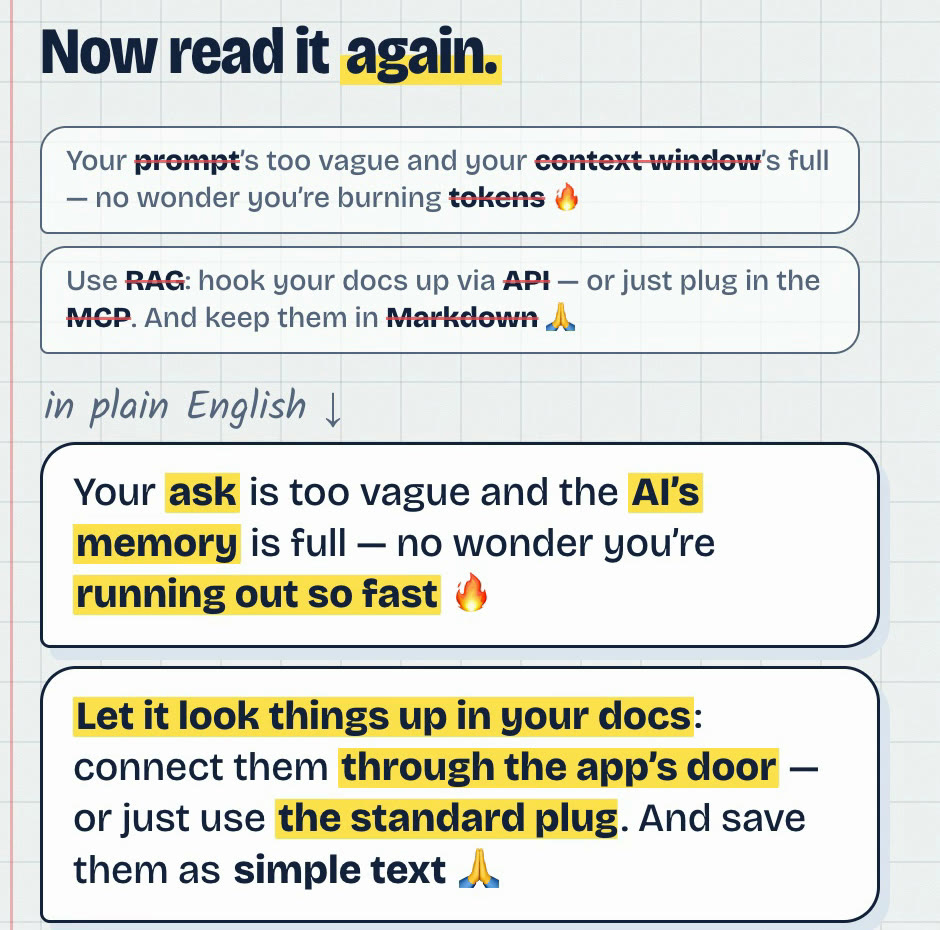
In plain English, the colleague was saying: your request is too vague and the chat is too long. Let the AI look things up in your documents instead of pasting everything, connect your apps the standard way, and keep your notes as simple text files.
One habit helps more than any glossary. When a word stops you, ask the AI itself: "Explain [word] like I'm new to this, with one everyday example." It's very good at that.
Which word next?
This is the first episode of Plain English, please. Tell us on Instagram which AI word still confuses you, and we'll decode the most-asked ones next.
Illustrative examples. The voices and sound effects in the video were made with ElevenLabs. Token counts with OpenAI's o200k tokenizer (tiktoken), checked on 18 October 2026; other models split text differently. The 150,194 tokens come from a real, logged agent run with a fictional client, explained in Where do your AI tokens go? The MCP quote is from modelcontextprotocol.io.