The Underrated Advantage of Speaking to Your AI
When we speak instead of type, we give the AI more context without trying. Why that often helps, and when the keyboard is still the better tool.

When you want useful help from an AI, most of the time you sit down and type. A question, a short explanation, maybe a list of bullet points.
But there is another option that is still underused: speaking.
Again and again, people notice the same thing: when they talk to an AI instead of typing, the answers often feel more on point and more relevant to their real situation. This is not because voice is a more advanced technology. It is because we humans communicate differently when we speak than when we write.
In this article, we will look at what changes when you speak instead of type, why that usually means giving more context to the AI, when voice really helps, and when typing is still the better choice.
How speaking is different from writing
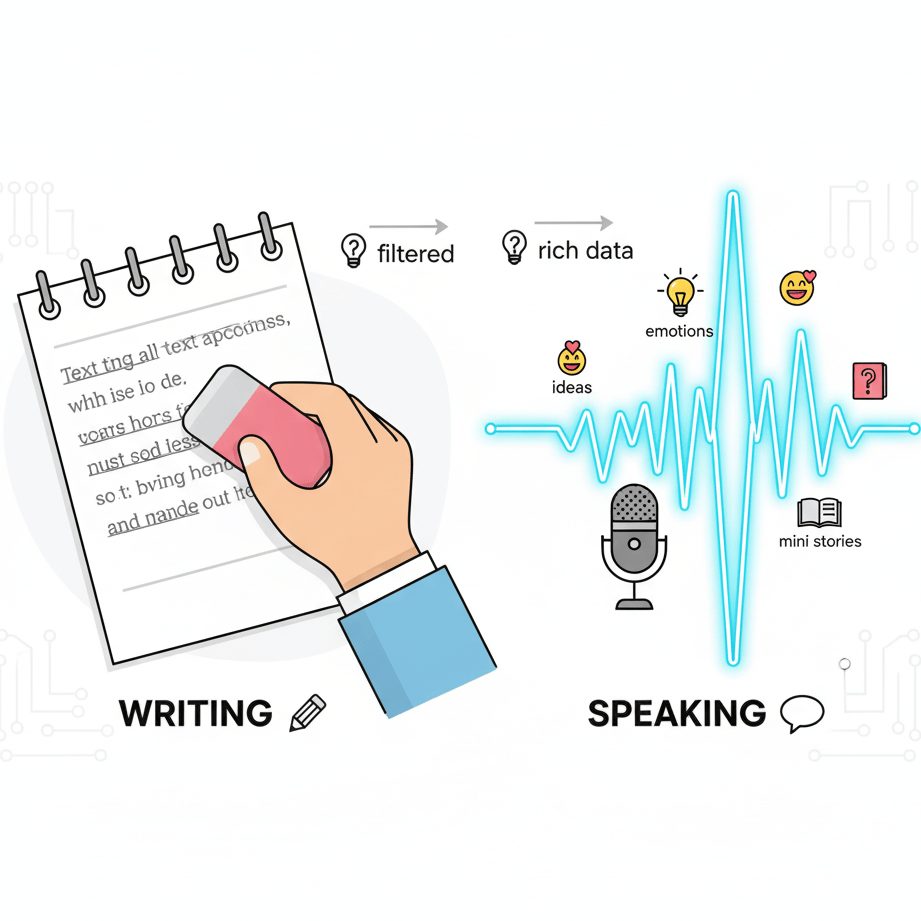
When you write, you normally edit yourself. You think for a moment, decide what is important, and turn it into short, clean sentences. You remove repetition. You skip details that feel obvious. You try to be efficient.
When you speak, you do almost the opposite:
- You think out loud.
- You correct yourself in the middle of a sentence.
- You add small stories and examples.
- You say “oh, and another thing…” and add new details.
Spoken language is usually more spontaneous and informal. It is less polished, but it contains a lot of extra information: emotions, doubts, side notes, things you are not sure about yet.
For an AI system, this “messiness” is often an advantage. The model does not care if your sentence is perfect. It cares about having enough information to understand what you need.
Speaking gives the AI more context
Studies that compare voice and text interaction with computers have seen a clear pattern: when people speak, they tend to give longer and richer answers than when they type.
That fits with everyday experience. When you dictate a problem to an AI instead of typing it, you naturally:
- Explain more background.
- Mention constraints you are working with (time, money, people, energy).
- Say what you have already tried.
- Add small details that you did not plan to mention.
All of that is context. And modern AI models are built to take advantage of context: the more they know about your situation, the easier it is for them to give a response that fits you, not just a generic answer.
The “think out loud” effect
In psychology, there is a method often used in experiments called “think aloud”. People are asked to say what goes through their mind while they solve a task: what they are considering, what they reject, what confuses them.
The goal is simple: not just to see the final answer, but to see how they got there.
When you speak to an AI, something similar happens. You do not only say what you want, you also reveal parts of how you are thinking about it:
- Why this problem matters to you.
- What you are worried about.
- What you have already considered and discarded.
- What a “good” answer would look like in your case.
That thought process becomes extra input for the model. The AI can use it to:
- Ask better follow-up questions.
- Point out contradictions.
- Adapt the tone and level of detail.
Again, the key is not the microphone itself. It is the fact that, when you speak, your reasoning becomes more visible.
More context usually means better answers
There is a basic rule that many AI practitioners see every day: vague prompts produce vague answers.

When you give an AI a short, abstract question with almost no context, the response tends to be generic. When you provide more details about your situation, the answers usually become more precise and more useful.
Voice helps here because it makes it easy to turn a one-line question into a one-minute explanation.
However, more is not always better. Very long prompts full of unrelated details can confuse the model and make it harder for it to focus on what really matters. There is a balance:
- Too little context → the AI has to guess.
- Too much noise → the AI loses the thread.
Speaking naturally often hits a good middle point: you give enough context to paint a clear picture, without having to “engineer” every line of your prompt.
When typing is still the better choice
Voice is powerful, but it is not always the right tool. There are situations where reaching for the keyboard is smarter:
- Code and formulas: Exact syntax is much easier to paste or type than to dictate.
- Legal, financial or safety-critical text: Many people prefer the control of written language and the ability to review each word.
- Noisy or public environments: Background noise, privacy and social comfort matter.
- Quick fact questions: If you just need one simple fact, typing a few words is often faster.
In other words, voice is especially useful for complex, fuzzy or human problems. Typing still shines when the task needs precision, silence or a clear written trace.
A simple way to combine voice and text
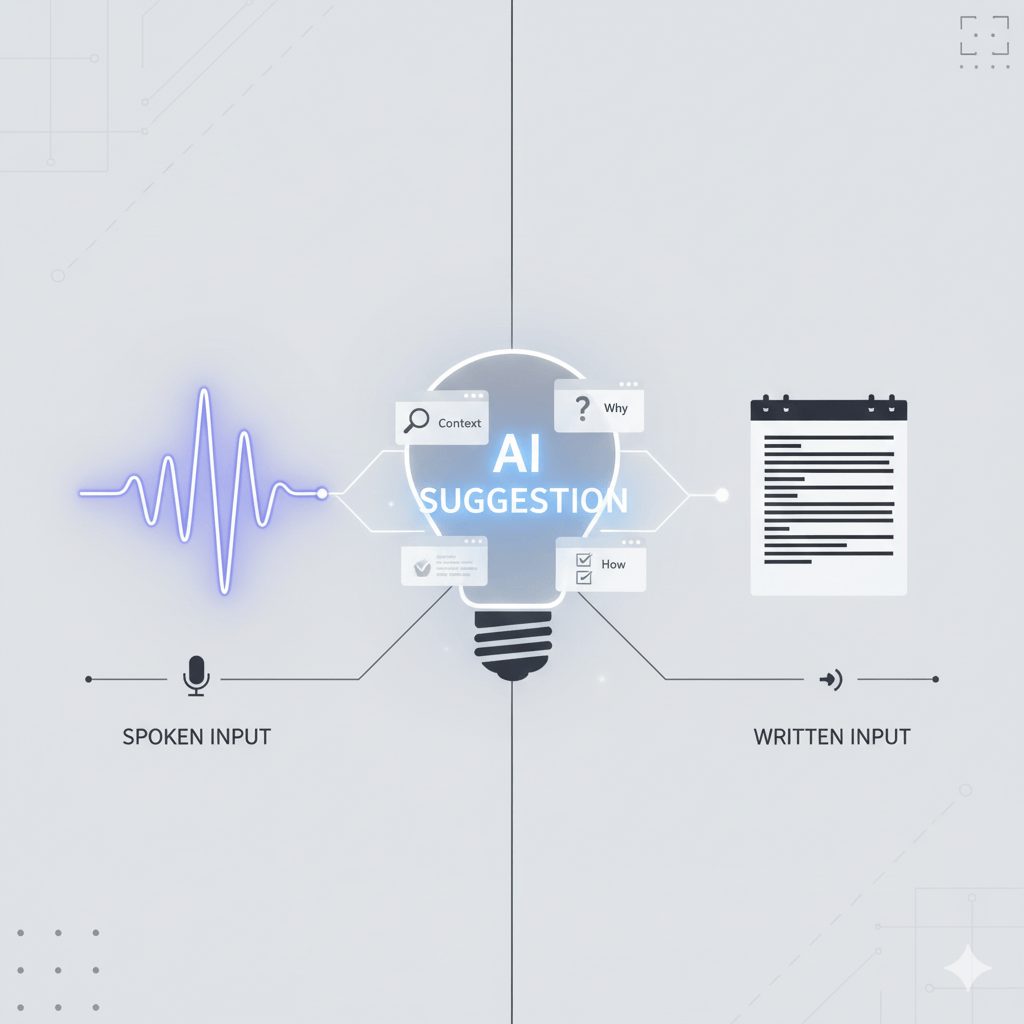
You do not have to choose between speaking or typing. In practice, a combination works very well:
- Start by speaking to explain the situation in your own words.
- Let the AI summarise what it heard and show it back to you.
- Edit and refine that summary by typing: add constraints, correct details, specify the format of the answer.
This way, you use voice to get all the important context out of your head, and text to clean it up.
So now the question is: will you start using voice and dictation more often with your AI, or do you still prefer to keep everything 100% written?